Species report trend

Rainbow Trout Fishing Report

Oncorhynchus mykiss

Rainbow Trout fishing activity is based upon real fishing reports collected over a decade, by Getfished. It represents an overview of all reports. With 2110 reports across 200 reported locations, the dataset helps show longer-term fishing patterns rather than isolated catches.

Freshwater Check local regulations

Rainbow Trout Seasonal pattern Report activity is strongest through spring, with winter also contributing a notable share of reports. Activity is lower through summer.

Rainbow Trout Bait and lure signal Reported bait patterns commonly include Powerbait, Worms and Scrub worms. Lure reports are led by Powerbait, Tassie devils and Strike tiger micro minnow black caviar.

Dataset context These patterns reflect observed report behaviour across time and locations. They highlight trends and tendencies, not guaranteed fishing outcomes.

Fishing rules Rainbow Trout fishing closures and regulations may apply in your state. Check local rules before fishing.

Share Your Latest Fishing Report

Help other anglers by sharing recent catches, bait, conditions, and what’s happening at your local fishing spots.

Share Rainbow Trout fishing reports

Report patterns

Rainbow Trout report signals

Derived from fishing report data

Bait and lure patterns

These percentages show the share of bait and lures found in reports for this species. They reflect observed report patterns, not universal recommendations.

Reported bait

Powerbait 46.4%
Worms 20.0%
Mudeye 3.3%
Powerbait (sherbet) 2.1%
Scrub worms 6.7%
Pilchard fillets 1.4%
Berkley powerbait 1.2%
Berkley powerbait nuggets 0.7%
Glassies 0.7%
Nathalia euro worms 0.7%
Strike tiger nymphs 0.7%
Mudeyes 0.7%

Reported lures

Powerbait 12.9%
Strike tiger micro minnow black caviar 6.0%
8cm pontoon21 jointed minnow 4.8%
Tassie devils 9.2%
Celta spinners 1.6%
Spinners 2.2%
Soft plastics 3.8%
Small minnows 4.5%
Strike tiger nymphs 0.9%
Tassie devil lures 3.5%
Rapala f7 0.9%
Hardbody lures 0.6%

Seasonal report pattern

This shows when rainbow trout reports appear across Australian seasons. Shares are based only on reports with parseable dates.

Autumn and summer show the strongest reporting activity, with reduced reports during winter.

Note: seasonal patterns may be influenced by factors such as reporting bias, species behavior, and environmental conditions.

Summer 11.2%
Autumn 17.3%
Winter 33.7%
Spring 38.6%

Reported rainbow trout locations

These locations come from report records. Linked locations have matching Getfished location pages.

Thornton

166

Goulburn River

View location forecast and local fishing context.

Lake Eildon

138

Lake Eildon

View location forecast and local fishing context.

Lake Victoria

115

Maryborough

View location forecast and local fishing context.

Crusoe Reservoir

106

Bendigo

View location forecast and local fishing context.

Wurdiboluc

90

Surf Coast

View location forecast and local fishing context.

Shepparton Lake

89

Goulburn River

View location forecast and local fishing context.

Great Lake

78

Reported in fishing data but not yet mapped to a Getfished location page.

Lake Purrumbete

69

Crater Lakes

View location forecast and local fishing context.

Nagambie

47

View location forecast and local fishing context.

Bronte Lagoon

45

Reported in fishing data but not yet mapped to a Getfished location page.

Lake Hume

42

View location forecast and local fishing context.

Lake Bullen Merri

41

Crater Lakes

View location forecast and local fishing context.

Eildon Pondage

36

Lake Eildon

View location forecast and local fishing context.

Lake Tom Thumb

36

Bendigo

View location forecast and local fishing context.

Kennington Reservoir

34

Bendigo

View location forecast and local fishing context.

Woods Lake

34

Reported in fishing data but not yet mapped to a Getfished location page.

Arthurs Lake

33

Reported in fishing data but not yet mapped to a Getfished location page.

Penstock Lagoon

30

Reported in fishing data but not yet mapped to a Getfished location page.

Bonnie Doon

28

Lake Eildon

View location forecast and local fishing context.

Lake Nagambie

28

Nagambie

View location forecast and local fishing context.

Lake Dartmouth

26

View location forecast and local fishing context.

Yarrambat Park Lake

24

Melbourne

View location forecast and local fishing context.

Warburton

23

Yarra Valley

View location forecast and local fishing context.

Kennington

22

Bendigo

View location forecast and local fishing context.

Rainbow Trout Fishing Guide
Rainbow Trout Fishing Reports

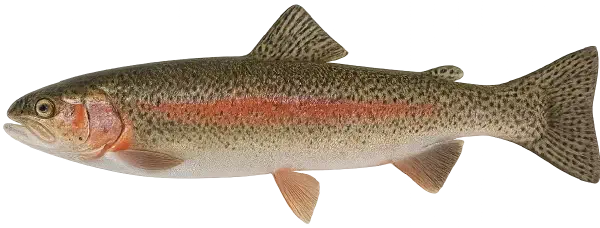
Rainbow trout are a cold-water freshwater salmonid, known scientifically as Oncorhynchus mykiss and belonging to the Salmonidae family. They have silver flanks, a dark green back with black spots, and a pink flank stripe that can deepen toward red or orange in spawning fish. In Australia they are associated with cooler, higher-elevation waters across New South Wales and Victoria, with records also from Tasmania, parts of South Australia, south-western Western Australia, and Spring Creek in southern Queensland. Some sea-run fish occur in Tasmanian estuaries. Productive water is clear, cold, deep enough to hold fish through warmer periods, and well oxygenated, ideally about 10 to 16 degrees Celsius.

The fishing context is shaped by temperature, oxygen, spawning behaviour, and local regulations. Rainbow trout favour clear rivers with shingle or rocky bottoms, deep water, and tree cover, and they also live in lakes where cold deep water is available. Spawning requires gravel or small stones with oxygenated water filtering through the bed, usually in mountainous upper river reaches and tributaries. Both Australia and New Zealand apply restrictions on when and how trout can be caught. Seasons vary by waterway, especially where spawning waters or tributaries are closed, so current local rules should be checked before targeting them.

Rainbow trout are carnivorous. Young fish feed on aquatic and terrestrial invertebrates, worms, molluscs, and crustaceans, while adults also take small forage fish. They are not limited to one feeding window, but night can be useful for larger fish because they may move closer to shore. In rivers, spinning tactics focus on casting across current and letting lures swing deep toward slack water, keeping them near the bottom before a steady retrieve. Slower lakes and gentle river sections suit hard-bodied lures worked uniformly, while deeper pools and lakes can suit soft plastics allowed to fall before being lifted and dropped.

Gear can stay simple and light. Spinning may use an 8 lb mainline with a 6 to 10 lb leader, adjusted for fish size. Fly fishing can be approached with a six-weight rod and reel, floating line, backing, and 4 to 8 lb tippet or leader. Nymphs imitate underwater insect stages and can be drifted downstream through slack water, with an indicator optional. Dry flies cover surface insects, while streamers and wet flies imitate small fish or swimming nymphs.

Explore more Fishing Reports.
Share Rainbow Trout fishing reports

Rainbow Trout is also known as:

Rainbow, Stonker Rainbow, Stonker Rainbow Trout.