
Buying a Secondhand Boat Trailer? My 10 Mistakes!
TL;DR
- Inspect the trailer as carefully as the boat; it is often the weakest and most dangerous part of the package.
- Check the frame, rust, bearings, wheels, tyres, rollers, winch, straps, chains, lights, tow hitch and jockey wheel before buying.
- Make sure the trailer fits your tow ball and has proper safety chains and shackles.
- Do not trust old winch straps, ratchet tie-downs or missing bow safety chains; replace them if doubtful.
- Trailer lights must work before you drive away, especially because boat trailer wiring often corrodes.
- Take your time; a cheap boat package can become expensive fast if the trailer is unsafe or neglected.
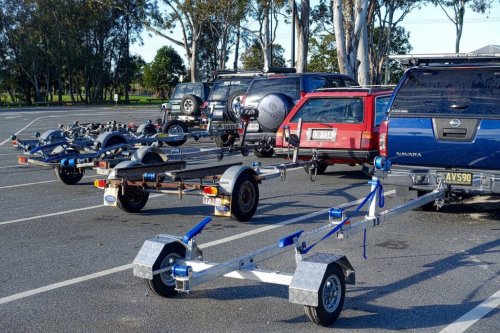
When we buy a secondhand boat trailer, we usually don’t pay as much attention to it as we do to the boat itself. Most of us just want to get out on the water and start fishing, right?
That’s definitely true, at least the first couple of times.
But while it’s understandable, ignoring the trailer can be risky. It’s often the weakest part of the whole setup.
I’ll admit, I’ve made mistakes with this myself—twice, in fact. There’s a lot you need to think about.
But if you follow some basic steps and pay attention to the details, you can avoid most problems.
First, we need to take a step back from our excitement about the boat itself.
Why is that important?
Because the trailer can be the difference between a great day out and a ruined boating experience.
It could even save someone’s life.
A broken or badly worn part on the trailer can easily cause a serious accident on the road.
As you’ll see in this article, I learned this the hard way and had a couple of close calls myself.
Note with each point mentioned here. A fault, minor or severe, doesn’t necessarily mean the seller is trying to rip you off.
Not everyone knows the basics. Sometimes people are selling a trailer from a deceased estate and genuinely don’t know the risks involved.
Table Of Contents
Secondhand Boat Trailer Bearings
The bearings are literally the number one reason you see boat trailers broken down on the road.
The bearings literally help the wheels spin. A seized bearing locks up the wheel. The result can be damage to the tyre, at best, or the entire wheel can fly off.
You really do want to avoid that “lump in the throat” feeling. You’ll find you experience this when your wheel overtakes you on the highway!
Don’t think it can happen to you?
Your boat trailer is getting dunked into water nearly every time you launch and retrieve your boat. Water corrodes metal. Saltwater is even more corrosive. Without care, it becomes not if – but when.
Bearings Are The Bain Of Secondhand Boat Trailers
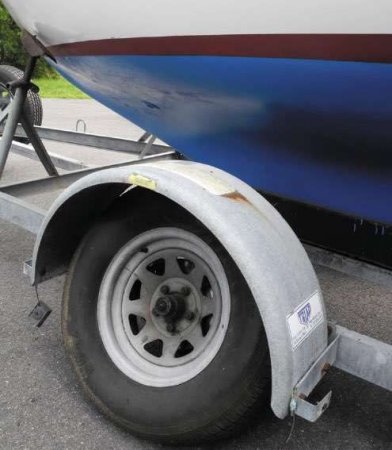
It’s critical when buying a secondhand boat trailer that the current owner has serviced the bearings. The seller’s statement that “the bearings will need servicing soon” is a red flag.
So is “I don’t know what kind of bearings they are” when you ask. If they’ve been serviced, they would likely know. At least, they should be able to check for you, even by looking at an invoice from their mechanic.
In Australia, most boat trailer hubs are either Holden (HT or HQ) or Ford. Less common are Holden Torana, Mini Minor and Land Cruiser. Trailer manufacturers around the world tend to use common local configurations.
The fact is, some “Holden” wheel hubs use Ford bearings and vice versa. To make life difficult, some use a combination of both.
Knowing this is essential knowledge.
A Holden HT hub won’t fit a Holden HQ rim. The same goes for Holden vs Ford hubs and rims. The stud patterns are completely different.
As it turned out, when I bought my second boat trailer, it used Holden HQ rims and Holden bearings.
The mechanic was able to service them fine. But I wasn’t sure whether the rims were HQ. After a lot of Googling, I found out how to tell. Simply by measuring the distance between the centre of two wheel studs (what the wheel nuts screw onto)
Vital knowledge, as I needed to buy a spare rim and tyre because the seller – and I – had overlooked including one (I’m being generous).
To save you the trouble, I’ve included the table below.
Finding The Wheel Stud Pattern On A Secondhand Boat Trailer
| Type | No. of studs | Stud diameter (inches) | PCD (inches) | PCD (mm) | Stud distance (mm) |
| HT Holden | 5 | 7/16 | 4 15/16 (4.9375) | 108 | 63 |
| HQ Holden | 5 | 7/16 | 4 3/4 (4.75) | 120.6 | 71 |
| Ford Falcon | 5 | 1/2 | 4.5 | 114.3 | 67 |
| LandCruiser | 6 | 1/2 | 5.5 | 139.7 | 70 |
| Torana | 4 | 7/16 | 4.0 | 101.6 | 72 |
Buying a secondhand boat trailer means you’re probably going to want to tow it home. If the bearings are in bad shape, you may not make it home.
Bad bearings are not usually quiet. They make a noise.
Secondhand Boat Trailer Bearing Checklist
- Hook the trailer up to a car (your own or the sellers.) This stabilises the trailer.
- Then jack up one side until the wheel can be freely spun.
- Spin the wheel. Take care to keep your hands free from the trailer frame and mudguard.
- It shouldn’t make any noise other than the sound of the wheel rotating on the axle.
- Grinding or humming sounds tend to indicate a bearing problem.
- So does wobble. Rock the wheel. If the wheel wobbles, the bearings are useless.
- Repeat for each wheel.
- If the seller won’t let you do this -no sale! Walk away.
Here’s my experience.
My second boat, a 3.7-meter tinny (around 12 feet), looked pretty clean. Some dents in the aluminium. The motor was good and was only 3 years old. Only a little surface rust on the trailer, all wire-brushable.
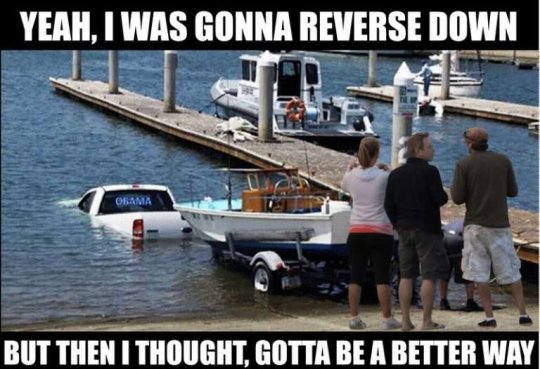
On a secondhand boat trailer, there will be some rust. Light surface rust here or there is OK. Deeper and more widespread rust is a problem for newbies.
Also, beware of freshly painted but clearly old and maybe rusty ones when buying secondhand boat trailers. Paint is sometimes used to cover up major structural rust. Even more so if they’ve used a paint such as “Hammercoat.”
All the components on the trailer were in as-new condition. Winch, jockey wheel, lights, etc.
The seller tells me, “You’ll need to service the bearings soon.” Not really appreciating how to check, I accepted this as friendly and wise advice to do ASAP.
I’m not saying he was trying it on. Rather, it’s possible he didn’t know. Which means the chances of the bearings being serviced are pretty slim.
I asked what make of bearing. He didn’t know. This alone should have ended the discussion with a firm no-thank-you and a walk away from the sale.
Why?
Because I was almost 100km from home, the route home was via two Freeways. The Princess and the Western Ring Road. Both are very busy major routes.
Again, that’s not to say he was hiding anything. Rather, if you’ve had the job done regularly, the brand is one of those things you’re going to remember.
Hindsight, as they say, is 20/20 vision!
But when it comes to buying a secondhand boat trailer, you need all the knowledge you can get before you buy!
In my opinion, failing to maintain bearings is a strong indicator that other mechanical aspects of both the secondhand boat trailer and the boat are likely to be suspect.
The Wish I’d Checked The Bearings Secondhand Boat Trailer Waltz
Paid for the boat and headed home. After getting onto the Princess Freeway at Geelong, to head back to Melbourne (99.6km or 61 miles to my suburb), I wound the window down. Only to hear an awful whirring sound coming from the trailer.
Got out to feel the temperature of the wheel hub (placing hand gingerly on bearing caps). Warm. But not hot. I ended up stopping every 20 minutes or so to check. Same thing every time. Very warm, but not hot.
Made it home—a very stressful drive. I don’t recommend it. If I’d checked the bearings, as outlined above, I would never have bought the boat despite everything else being in pretty good shape overall.
If they had broken, I would have been completely up the creek because it was New Year’s Eve.
At that time, I did not have a roadside assistance cover that would have included the boat—something I strongly recommend.
The bearings were replaced before I took the boat out for the first time. It was only a few hundred dollars, including labour. Worth every penny! A lot less if you are confident doing it yourself.
In my case, with chronic asthma, I paid a local boat service centre and was glad to do so.
There were a few other issues with the secondhand boat trailer I bought. Things you need to make sure you check.
I’ll get into some of those things below.
Tyres - Huh - Who Needs A Spare, Live Free, Man. Bah!!!
Buying a secondhand boat trailer in most Australian states means you don’t need a Roadworthy Certificate. So common-sense safety checks are your responsibility.
The tyres are important. There should be plenty of tread, no worn rubber marks. They should be fully inflated.
Many boat trailer tyres are designed for light trucks. This helps ensure they can support the boat’s weight on the trailer.
As such, they commonly take up to 40 PSI of air. While a lighter boat may sit better when driving with a little less inflation (I wouldn’t go below 34 PSI personally), it’s a good idea to check the inflation.
Buying a secondhand boat trailer in most Australian states means you don’t need a Roadworthy Certificate. So common-sense safety checks are your responsibility.
The tyres are important. There should be plenty of tread, with no worn rubber marks. They should be fully inflated.
A simple pressure gauge is invaluable. Not just for when you are purchasing the boat and trailer. But when on the road, too. For the times when you stop and check your trailer (a must-do procedure).
I bought a digital one from Aldi a few years ago. It is accurate and has been invaluable.
During purchase, low inflation can indicate a possible slow leak. Certainly not foolproof, however.
You’ll want to inflate a deflated tyre and check for leaks.
I bought a decent tyre pump from Repco some years back for about a hundred bucks. Always in my car. Better than stopping at a service station!
Rim size is less important, up to a point, on smaller, lighter boats. Bigger boats require more attention here. You have to balance the load capacity of the tyre with the height of the boat on the trailer, from the water, when you’re launching on the boat ramp.
Large rims with tyres can make launching and retrieving bigger boats more difficult. This is why larger boats often have twin axles with relatively smaller wheels. Two tyres on each side of the trailer.
This gets the boat into the water without needing to back down the ramp as far (deep). Conversely, a larger wheel on a smaller boat helps keep your bearings out of the water. This can extend the life of your bearings.
Make sure the tyres clear the mudguards – also known as the “fender.” If it rubs easily, you’re reducing your tyre life. It will stick you up somewhere. It could even lead to shredded tyres.
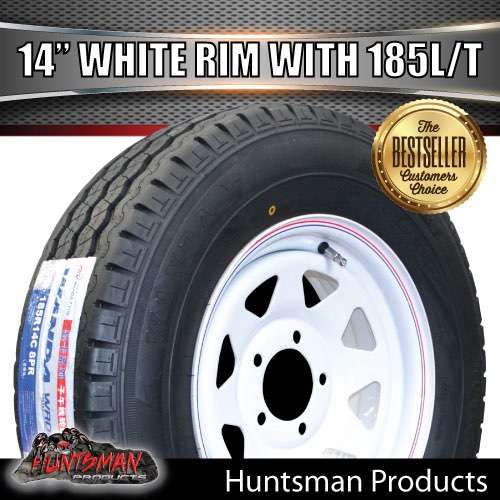
In the case of my second boat. The trailer came with 14-inch rims. With 185/R14 tyres. I replaced these with a lower-profile 175/R14 tyre. The smallest profile I could get for the HQ wheel hubs. Lowering the height slightly and allowing more mudguard clearance.
For the record. The rims looked pretty awful. Old, flaky black paint and some minor, but ugly, rust. They were serviceable. But I intended to replace them with a set of nice Sunraysia white rims from Huntsman Products. I chose a Melbourne dealer because they offered a good deal. I bought the rims with the tyres on and fitted them to the trailer at home.
I’m not affiliated with the company and receive nothing for mentioning them. But their service and products are excellent, and I love supporting local Aussie businesses.
I honestly screwed up the order. I ordered the wrong tyre profile, which would not have fitted under the trailer mudguards. They exchanged them for me. Even refunded the $30 difference—very friendly and helpful folks.
Get A Spare Tyre With Your Secondhand Boat Trailer
Make sure you get a spare tyre with the secondhand boat trailer. Pretty easy to overlook.
How do I know? Because I forgot to check!
The second boat I bought, and I was under pressure. Everything looked good. Had to get the wife back to Melbourne. It was New Year’s Eve—almost 100km from home.
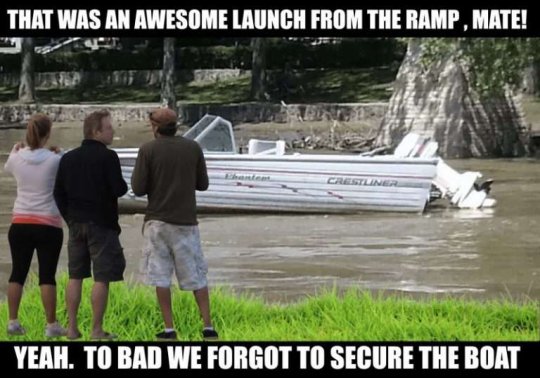
So, like a complete twit, I failed to check if the trailer had a spare wheel.
Just didn’t occur to me.
When you are buying a secondhand boat trailer, with or without the boat, the spare tyre is probably the number one thing you might need – on the way home!
I was lucky in that I didn’t get a flat.
But keep in mind. You’ll need to know the rim size, tyre size, and stud pattern if your trailer doesn’t have a spare tyre. See the table I included above for instructions on checking stud patterns.
Some secondhand boat trailers come with a spare tyre thrown into the boat. My first boat came that way.
That’s OK. As long as it fits and is a legal, serviceable rim and tyre.
Others come with the spare neatly attached to the trailer, often on the frame. This is excellent. But not essential. You can always buy your own mount and DIY it later.
This is also one of the first things I did on the second trailer – after buying the spare.
Something I recommend as it’s easy to forget to “load the spare” into the boat. Or your car boot. Leaving the spare tyre at home might ruin your day – or holiday!
Yeah. Not a lot of fun. While I hadn’t done that so far, I figured it was pretty much Murphy’s Law in play on this one. Buy and fit the mount!
While we’re still on the topic of secondhand boat trailer wheels. I recommend buying a good-quality hydraulic jack if you don’t already have one. The scissor jacks that come with your car are awkward to use, if not dangerous.
I also carry a couple of small car stands in the boot. It just makes everything so much safer. Obviously, these tools can sometimes be chosen to work with the tow vehicle too.
Finally, make sure you have a wheel brace that matches your trailer’s wheel nuts. The ones that come with cars are often single fit. Which probably won’t help you if you get a flat tyre on the side of the road.
I’ve yet to see a secondhand boat trailer that came with a jack, wheel brace or anything else, beyond the spare tyre.
Mudguards AKA “Fenders” On Your Boat Trailer
You need these by law in all Australian States (and probably most other sane places in the world!)
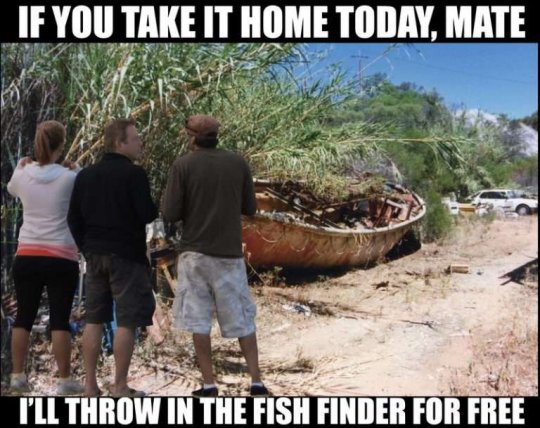
I’m embarrassed to say, in the excitement of buying my first boat, I overlooked these completely.
They were not “attached”, and the reason was simple. If they had been attached, they would have been horrific. They were so badly rusted as to be useless. Little doubt in my mind that the seller knew this.
I found them in a box inside the boat when I got home, along with some “extras” the seller had “thrown in” for me.
Too late to realise the mistake I’d made.
The way the trailer was set up, they didn’t seem to be missing, which is why they were easy to overlook.
No worries. Bought some new ones. Made a bracket to attach them to the boat trailer. The guards worked out fine. The secondhand boat trailer itself?
Well – that’s another story. See “Frame Rust” below….
Frame Rust On Secondhand Boat Trailers
On a secondhand boat trailer, there’s “frame rust” and “frame rust.”
The first kind is superficial. It can be scrubbed off with a wire brush or, if necessary, a sander. Then you can add rust killer, paint it up, etc.
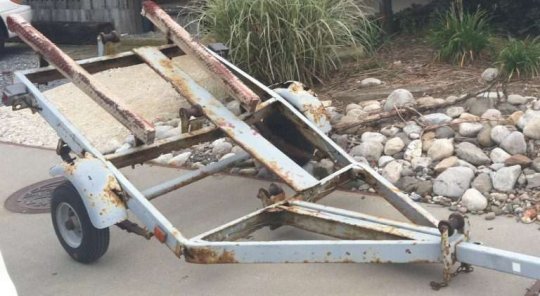
Then there’s the kind where the rust has eaten right through the frame. Leaving only a veneer of metal.
The metal will be flaky. Soft. Often, like layers of honeycomb. Basically useless.
Don’t buy a secondhand boat trailer in this state. No matter how much you think you can fix it. Unless you can weld confidently or have someone in the family who can.
Because it’s going to get expensive – fast – to fix. In the case of my first boat, a new trailer.
Why did I replace the trailer?
Because it broke.
On the highway. First trip out with the boat.
Leaving me with a boat heavily listing. Limping down the remaining 15km to the town we were planning on staying at.
Look. I’m a programmer—a tech geek. I had no idea what I was getting myself into.
I was lucky because:
- It didn’t cause an accident
- I was able to drive to the town slowly
- No police officer saw us and gave us a much-deserved infringement
- The holiday park we were staying at had a handyman who was able to effect a welded repair with some steel for $50.
- The holiday park folks at Lake Nagambie Leisure Park were awesome about it all.
- Nobody uploaded a video of me to Dashcams Australia on YouTube.
- The guy who sold it to me knowing this… The less said, the better.
The entire thing was that much harder because it was a fibreglass boat, which weighs four to five times as much as an aluminium boat of the same size.
See the image above. If the rust is even a fifth as bad as you see in the photo, walk away.
In the case of my first secondhand boat trailer. Well, it’s pretty amazing what can be hidden with judicious use of paint if you’re determined to make a sale. So I discovered on the side of the Hume Highway just outside Seymour.
The very over-engineered mudguard brackets that I’d made, of all things, literally held the boat and trailer together as we limped into town. So my first introduction to Lake Nagambie Boat Ramp was a real ordeal. I had to get the boat off the trailer to have the trailer repaired. The mission was accomplished – but nerves were definitely on edge.
Are there exceptions to the rule?
The only one I can think of is where you are confident you can rebuild the trailer. Or will be replacing the trailer.
With smaller secondhand boats, the value of the trailer is rarely taken into account by newbie buyers.
So a secondhand boat-and-trailer package will often start at the $ 1,200 mark and above.
The fact is, a new trailer for a small boat, 12 feet or less, will cost around $1,200 or more, especially if the boat is in good condition. The motor is in good condition. The trailer is probably the weakest link.
You’ll find the converse is also true—great trailer, lousy boat or motor.
It’s going to cost you money. No matter what. A bad motor, in this price range, is often a better deal than a bad secondhand boat trailer. Providing the boat is OK.
Just make sure you understand the motor will be the first thing you replace, before you head out.
For a small boat, you can get a small motor (around 6hp) for under $1200 to get started. Another $ 1,200 on top, and you’ll get 10hp. You can pay less than this with a secondhand outboard motor - but buyer beware!
Tongue & Tow-ball Size On A Secondhand Boat Trailer
Not all tongues and balls are created equal.
I’m not talking about Mick Jagger or Gene Simmons here, either.
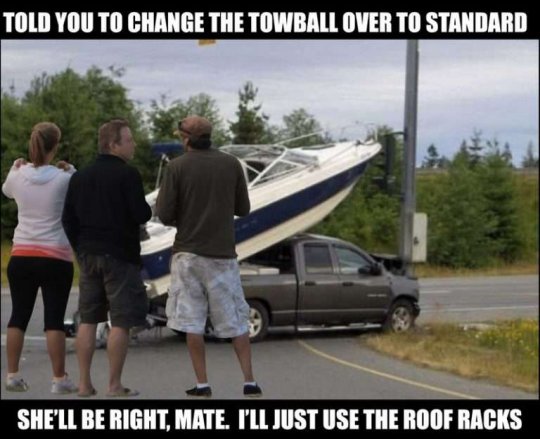
They do come in different sizes. A 50mm ball diameter is considered standard in Australia.
When buying my first secondhand boat trailer, I learned an immediate lesson.
After happily paying for my first boat, I filled out the registration transfer papers. Basically, feeling all warm and fuzzy.
Imagine my shock when…
The tow-ball size for the trailer tongue was too small for my standard 50mm two-bar ball!
The seller seemed pretty much sure that 50mm isn’t standard, even though it’s what he had on his car as well.
Fair dinkum! A real kick in the family jewels, that one.
OK. To be fair. The seller had a spare hitch, which he did fit with great difficulty.
To be fair. It then worked fine. However, if he’d not had one, I’d have had to buy another the next day and return it.
I could have changed the tow-ball. But then I’d have to change the tow balls every time I towed my box trailer. Plus – the guys who fitted my tow-bar had made darn sure my tow-ball wasn’t coming off.
Best to make sure it fits your tow-ball.
Safety Chains - Because Your Trailer Should Stay Behind You, Not Ahead Of You
On a final note on the trailer towing setup. Make sure the boat trailer comes with safety chains to attach to your tow-bar. This is not optional.
If the tongue comes off the ball, the chain is the only thing that’s going to keep your trailer from careening down the road.
On its own adventure.
Without you and your car.
Also, make sure there are shackles to attach the chain. Really easy to miss. While most service stations sell these, at a pinch, it’s best to come prepared. I always carry some spares that fit my tow bar in the glove box of my car.
Look, they’re easy to lose, yet are cheap to buy.
Did I learn this the hard way, too? Yeah. How’d you guess?
The first boat trailer didn’t come with shackles for the chain. Had to stop at a service station, on the side of the road, in peak hour, on a major suburban road.
The second boat trailer came with safety chains for attaching the trailer to the car. But didn’t come with any chains at all to attach the boat to the trailer. Just the winch strap; I tied it to the winch post using a rope (cringe!) that I had in the boot to get home.
Electrical – Lighting & Wiring On A Secondhand Boat Trailer
Stop lights, park lights and indicators need to work. It’s the law.
Trailer lights can be a real PITA. They are regularly dunked in water, often saltwater. So the opportunity for failed globes, corroded wiring, etc., is higher than in other kinds of trailers.

My first secondhand boat trailer came with the kind of batten that you remove before putting the boat in the water.
These are fine and legal. Provided they are in good working order. Just make sure they’re secured and can’t rise while driving. Not only is the noise of their banging annoying. They can also chip or dent your boat if left hanging freely. They can also be obscured more easily as the force of driving tends to push them upwards.
Easy fix. A bungee cord does the trick.
My next secondhand boat trailer came with them attached to the trailer frame. This works great, too. However, make sure you wash them down after immersion, especially in saltwater.
Make sure they work before you drive away after buying the trailer. If you’re not an electrician or an experienced DIYer, they can be a major nuisance to fix, beyond simply changing the light globes.
Winch, Winch Strap, Safety Chain, Bow Stop & Jockey-wheel, Ratchet Tie Down
A secondhand boat trailer has obviously been “used.” Sometimes they have been used a lot and sometimes, even abused. More often, neglected.
The winch is often left out in the elements. Even if the boat is covered, make sure it’s not rusted. It needs to function freely when cranked. The ratchet gear should allow you to lock it so that it doesn’t reverse when you want it to keep the boat on the trailer.
On my first boat, I had to replace the winch strap. It was badly frayed. While this isn’t expensive to do, it is certainly essential. Having it break while winching your boat on could leave you stuck at the boat ramp.
Having it break while towing, well, that’s going to be potentially very hazardous.
The same goes for the safety chain. My first boat trailer came with the safety chain. My next secondhand boat trailer did not.
Do not travel without the safety chain! The winch is not enough. They can – and do – fail. Allow the boat to fall off the trailer, onto the road.
In the case of my second boat. I tied it to the trailer, using the handle built into the bow to get it home. OK at a pinch. But not long-term.
So, before taking the boat out, I bought a stainless steel chain (overrated to 1 ton) and shackles to suit. Drilled holes into the winch post platform to attach the chain securely in place.
If the winch fails, the boat will stay on the trailer!
This is the kind of crazy logic that mystifies me. The original owner raves about how he used the boat at Lake Mulwala, over 300km from his home. He drove up a major freeway and highway without chains. Dozens of times for years?
Yet. For less than $30 for stainless steel chain and shackles – plus ten minutes work – you’ve got the safety setup all done and legal.
You tell me. Which makes more sense?
Jockey Wheel
The other often abused, but necessary item when choosing a secondhand boat trailer is the jockey wheel.
While not legally required, your groin and stomach will thank you for not developing a hernia lifting the trailer onto the tow-bar!
Not to mention moving the trailer around the yard.
If there’s something that is usually easy to replace, relatively cheap and a DIY item, it’s the jockey wheel. So while not immediately critical, it’s something you need to consider.
Ratchet Tie-Down
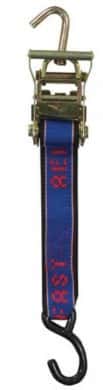
I’ve left this to last. The ratchet tie-down secures the back of the boat to the trailer. Unless the secondhand boat trailer you buy has newish ones, buy a new one.
I’ve found this to be a really unreliable piece of kit. Rusty ratchets on the tie-down will stick you up on the boat ramp as mine did. Rather than spring for the $30 or $40 new tie-downs, I stupidly decided to make do on my first boat.
Don’t fail to replace them. It wouldn’t lock properly, then failed utterly.
False economy.
Spend the money. It’s worth it!
Brakes On A Secondhand Boat Trailer – If Applicable
None of my boats required brakes. They were below the weight where they became mandatory.
However, if they are fitted, they need to have been serviced and be in good working order. On a trailer with brakes, the boat is likely over 1 ton (that’s metric – over 1000 kg).
So, faulty brakes on a secondhand boat trailer that needs them are a problem. This is a little more complex than checking bearings, rust, etc., on a secondhand boat trailer. So I recommend having them checked by a boat inspection service – or a family member if they are a mechanic.
Concluding Thoughts – Don’t Be In A Hurry!
There’s more to consider. I may have left something important off this list. If so, let me know via the Contact page. However, there’s more information than I started with.
Just make sure you take your time. Try to enjoy the browsing as much as the buying. In other words, don’t be in a hurry!
Taking your time. Looking for problems will save you money, time and possibly the life of others as well as your own.
Remember. Shonky operators are selling secondhand boat trailers. Some well-meaning people don’t know anything about the subject.
It’s your responsibility to make sure what you are buying is safe and serviceable.
In the budget range (below $3000) for a small boat (under 14 ft), trailer and motor, you are usually going to find that one of the three items isn’t equal to the others.
- A good boat, poor motor and poor boat trailer.
- A good boat, fair motor and poor boat trailer
- A good boat trailer, fair motor and poor boat
- A poor boat, good motor and a debatable boat trailer
- A poor boat, poor motor and good boat trailer
There’s a whole lot in between. You may find you need to shop for each of the big three separately.
For example, find a good secondhand boat. A good secondhand motor from another source (or a new one) and then a good boat trailer from yet another source (or a new one)
It depends widely on where you live, how far you are willing to travel and what’s available in the marketplace at the time you’re looking.
Take your time!
Comments
Rod
August 2, 2021, at 6:50 pm
You are extremely unlikely (if not impossible) to get an interstate-registered trailer registered in NSW.
– Reply
Dave says:
August 3, 2021, at 1:55 pm
G’day Rod, Thanks for commenting. That’s interesting about NSW, as I know it’s pretty easy in Victoria. I’ll look into why this is the case, as I had no idea it was so hard there! Clearly, safety is the concern.
Thanks Again!!
Share this post

Written by
Scott Kane
Founder, Getfished
Scott's a software developer and the founder of Getfished. He's a long-time recreational angler focused on practical fishing forecasts, fishing report data, and decision-support tools for Victorian anglers.
He has a background in complex software systems and data analysis. Scott has a penchant for building software using low level tools, developing products like Getfished in C, Pascal, SQLITE and Hugo.